



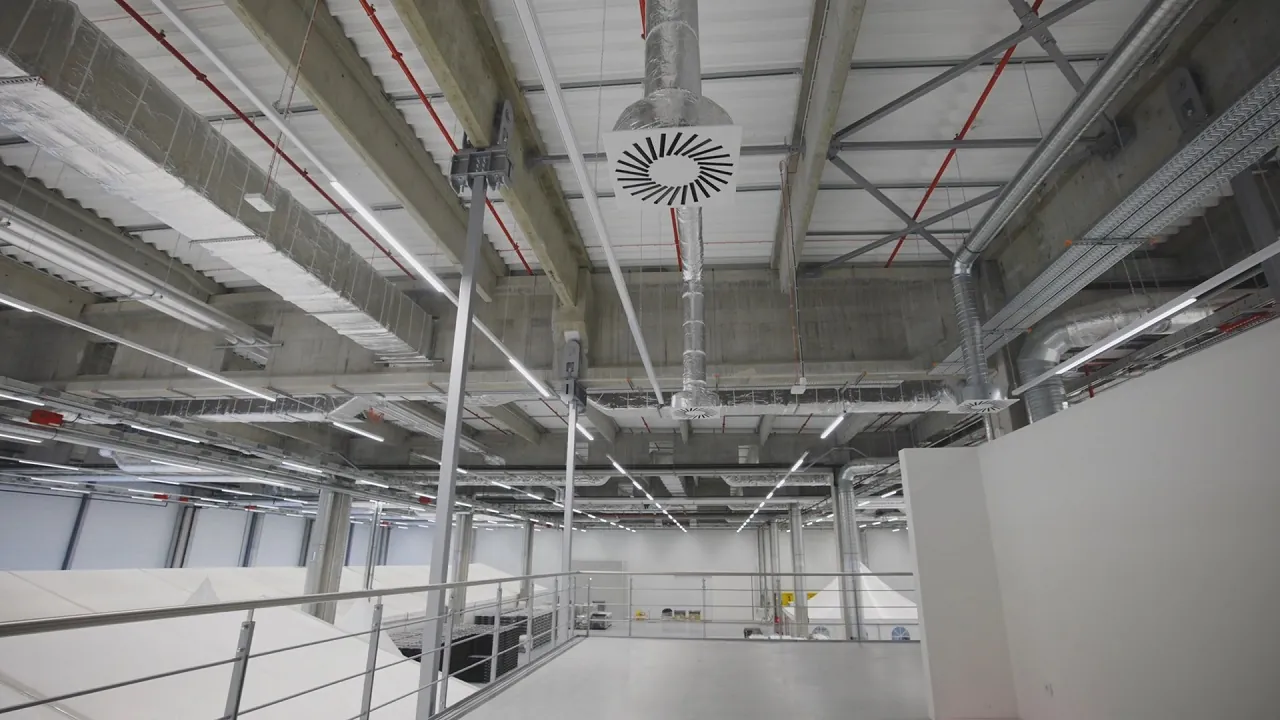
HVAC efficiency in large storage spaces depends on controlling air movement, zoning intelligently, and reducing unnecessary conditioning of unused volume.
The approaches that work are not advanced gadgets or oversized systems, but practical design choices such as destratification, demand-based control, targeted heating and cooling zones, and envelope improvements that reduce thermal loss.
Facilities that apply these methods consistently reduce energy use by 20 to 45 percent compared to traditional warehouse HVAC layouts, according to data from the U.S. Department of Energy and ASHRAE field studies.
Why Large Storage Spaces Are Uniquely Inefficient by Default
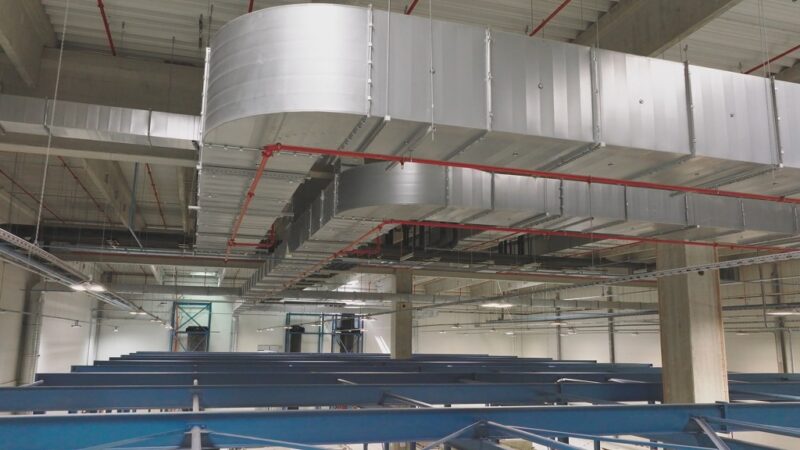
Warehouses and fulfillment centers present a structural problem for HVAC systems. Ceiling heights often range from 9 to over 14 meters, air volume is massive relative to occupied floor space, and occupancy is intermittent.
Traditional HVAC design treats the entire volume as equally important, which leads to conditioning air that is never used. In heating seasons, warm air stratifies near the ceiling. In cooling seasons, cold air drops unevenly and shortens the system.
According to ASHRAE Technical Committee 9.11, vertical temperature differentials of 8 to 12°C between floor and ceiling are common in unoptimized storage buildings.
Another issue is operational variability. Storage density changes. Racking layouts evolve. Some zones operate 24/7 while others remain inactive for days. HVAC systems that lack zoning or demand responsiveness continue to operate as if the entire space is fully occupied, leading to energy waste that compounds monthly.
Temperature Stratification and Destratification Reality
The single most effective intervention in large storage HVAC efficiency is controlling vertical temperature stratification. High-volume, low-speed fans, commonly known as HVLS fans, are not comfort devices but air distribution tools. Their purpose is to move trapped warm air from the ceiling back toward the floor during heating seasons and equalize air layers during cooling seasons.
Field measurements from DOE-supported warehouse retrofits show that destratification alone can reduce gas heating demand by 20 to 35 percent in cold climates. The reason is simple physics. When ceiling temperatures drop from 30°C to 22°C while floor-level temperatures remain stable, less heat escapes through the roof assembly. Roof losses are often the largest single heat loss component in storage buildings.
Table: Typical Vertical Temperature Profile Before and After Destratification
| Height Level | Without Destratification | With Destratification |
| Floor (1.5 m) | 17–18°C | 18–19°C |
| Mid-height (6 m) | 22–24°C | 19–20°C |
| Ceiling (12 m) | 28–32°C | 20–22°C |
This temperature equalization reduces HVAC runtime without raising thermostat setpoints. It works because it addresses distribution, not generation.
Zoning That Reflects Real Use, Not Blueprints
Most storage buildings are designed with HVAC zones based on architectural drawings rather than operational reality. Over time, this mismatch becomes costly. A high-efficiency system operating across a poorly defined zone still wastes energy.
Effective zoning separates spaces by function and occupancy pattern. Loading docks, pick-and-pack aisles, bulk storage, cold storage buffers, and office-adjacent zones should never share a single control loop.
Studies by the National Renewable Energy Laboratory show that re-zoning existing warehouse HVAC systems reduces energy consumption by an average of 18 percent, even without replacing equipment.
Modern zoning relies on variable air volume control and localized temperature sensors placed at working height, not near ceilings or returns. It also relies on setback strategies that allow unused zones to drift within a safe temperature band rather than maintaining tight comfort ranges.
Heating Works Better Than Cooling in Storage Buildings
Large storage spaces are far more energy-intensive to cool than to heat. Cooling requires removing heat from a massive air volume and often from internal loads such as forklifts, conveyors, and lighting. Heating, by contrast, can be localized and directional.
Radiant heating systems outperform forced-air systems in warehouses because they heat people and objects rather than air. Gas-fired radiant tube heaters and infrared panels are common in efficient facilities.
According to ASHRAE Journal case studies, radiant systems can reduce heating energy use by 25 to 40 percent compared to unit heaters in buildings with ceiling heights above 9 meters.
Table: Heating System Performance in High-Ceiling Storage Spaces
| System Type | Typical Ceiling Height | Relative Energy Use | Notes |
| Unit heaters (forced air) | 6–9 m | High | Strong stratification |
| Radiant tube heaters | 9–14 m | Medium | Heats objects directly |
| Infrared panels | 10+ m | Low | Minimal air heating |
Cooling strategies, when necessary, work best when combined with night purge ventilation and envelope shading rather than relying on full mechanical cooling during peak hours.
Envelope Improvements That Outperform Equipment Upgrades
Many operators invest in higher-efficiency HVAC units while ignoring the building envelope. This is usually backward. Insulation upgrades, roof sealing, and dock door improvements often deliver faster payback than mechanical replacements.
Data from the Building Owners and Managers Association indicates that sealing dock doors alone can reduce infiltration-related energy losses by 10 to 15 percent.
High-speed roll-up doors reduce air exchange during loading cycles, while insulated dock shelters prevent continuous leakage.
Roof insulation improvements from R-20 to R-30 in large storage facilities have been shown to reduce heating loads by up to 12 percent in cold regions and cooling loads by 8 percent in warm regions.
Controls and Automation That Actually Matter
Smart controls only improve efficiency when they reflect how the building operates. Motion-based HVAC activation in warehouses has limited value because thermal systems respond slowly. What works instead are time-based setbacks aligned with shift schedules, outdoor air temperature resets, and demand-controlled ventilation tied to CO₂ levels in occupied zones.
Warehouse operators who integrate HVAC control with warehouse management systems gain additional efficiency. For example, zones scheduled for overnight picking can be conditioned in advance while inactive areas remain in a setback.
This level of coordination is common in large third-party logistics facilities and prep centers that handle variable inventory volumes, including operations similar to those run by Dollan Prep Center, where throughput changes seasonally, and HVAC loads must adapt accordingly without compromising worker conditions.
Lighting and HVAC Are Not Separate Systems
High-bay lighting contributes significantly to internal heat gain. Traditional metal halide fixtures can add 4 to 6 watts per square meter of heat. LED retrofits reduce this load dramatically, lowering cooling demand in warm months and reducing overheating in winter.
Facilities that replace metal halide with LED lighting often report secondary HVAC savings of 5 to 10 percent annually. This interaction is frequently overlooked during HVAC audits, yet it has a measurable impact on runtime and peak demand.
Energy Benchmarks From Real Storage Facilities
Benchmarking data from ENERGY STAR Portfolio Manager provides context for what efficient operation looks like.
Table: Energy Use Intensity Benchmarks for Storage Buildings
| Facility Type | Median EUI (kWh/m²/year) | High-Efficiency Range |
| Non-refrigerated warehouse | 55–70 | 35–45 |
| Fulfillment center | 80–110 | 55–70 |
| Light industrial storage | 65–85 | 45–55 |
Facilities in the high-efficiency range consistently apply destratification, zoning, envelope control, and demand-based operation rather than relying on oversized HVAC equipment.
What Does Not Work, Despite Popular Claims
Oversizing HVAC equipment does not improve comfort and almost always reduces efficiency. Short cycling increases wear and prevents systems from operating at optimal load. Similarly, attempting to maintain office-grade comfort conditions across an entire warehouse volume is neither necessary nor achievable without excessive energy use.
Another common mistake is relying solely on thermostat setpoint adjustments. Raising or lowering setpoints without addressing air distribution and infiltration rarely produces meaningful savings and often leads to uneven conditions on the floor.
Final Observations
Efficient HVAC operation in large storage spaces is not about complexity. It is about aligning conditioning with where people work, reducing wasted volume, and preventing energy from escaping through the roof and doors.
Destratification, zoning, radiant heating, envelope control, and operationally aware scheduling consistently outperform equipment-focused solutions. Facilities that treat HVAC as a system integrated with building design and workflow achieve measurable, repeatable efficiency gains without compromising safety or productivity.